
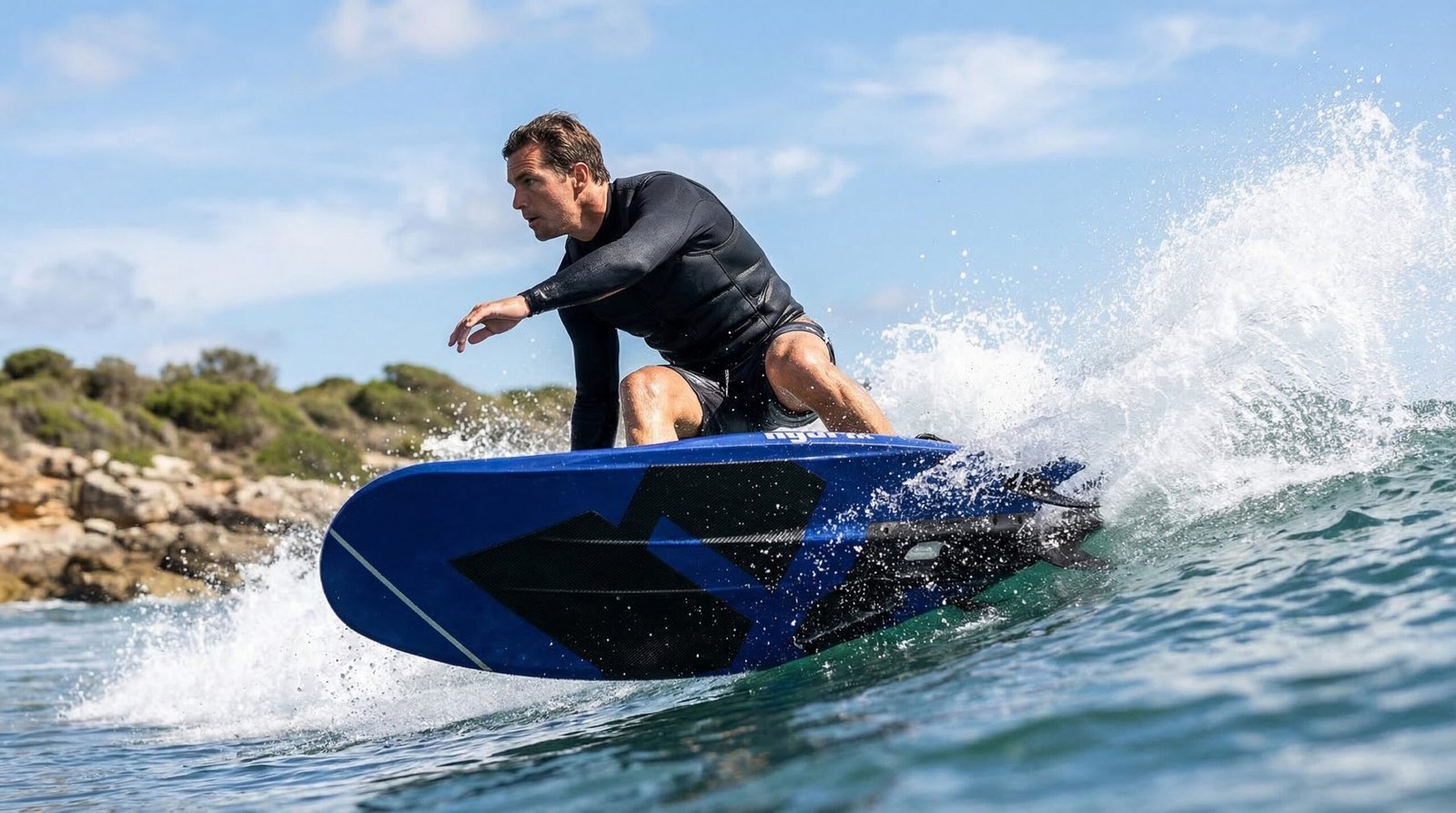
Imagine this: You‘re 1,500 yards from the shoreline, the sun is setting, and you’ve just carved the perfect arc. Suddenly, the roar of your internal combustion engine sputters and dies. Silence. But not the peaceful kind—the expensive kind.
For years, gas-powered jetboard riders have accepted a “silent risk” that many manufacturers won’t put in their brochures. It’s not just about a failed session; it’s about the very real probability of your $10,000 investment becoming an anchor.
1. The “Open Lung” Flaw
A gas engine is a living, breathing machine. It requires air intakes and exhaust ports to function. This is the fundamental design flaw in a marine environment.
When your board is moving, dynamic pressure helps keep water at bay. But the moment that engine stalls in deep water, those “breathing holes” become open invitations. Without the outward pressure of exhaust gases, seawater begins its slow, inevitable crawl into the engine displacement and the hull.
2.The Weight of Despair: A Sinking Sequence
Unlike a traditional surfboard, a gas jetboard is heavy, packed with a motor, a fuel tank (often mounted at the nose, compromising balance), and mechanical linkages.
The Stall: You pull the starter cord. Nothing.
The Intake: Every wave that washes over the deck sends a few more ounces of water into the intake.
The Physics: As water replaces air in the hull, the board loses its buoyancy. It doesn’t sink like a stone instantly; it’s worse. The tail begins to dip, the nose rises, and as the rider, you realize that without a third-party rescue, you are powerless to stop the descent.
3.”Surfer or Mechanic?” — The Barrier to Entry
Let’s be honest: owning a gas board requires you to be part-engineer. If you don’t have a deep understanding of spark plug fouling, carburetor ratios, and saltwater flushing, your board’s lifespan is a ticking clock.
Refueling is another nightmare. You cannot refuel safely on the water. A single spill not only ruins your day but contaminates the very environment you’re there to enjoy.
The Hydrix Response: Safety by Architecture
At Hydrix, we didn’t just swap a motor for a battery; we re-engineered the entire concept of aquatic mobility to eliminate these “legacy” anxieties.
IP68 Sealed “Vault” Technology
Hydrix boards don’t have “lungs.” There are no air intakes to flood and no exhaust pipes to backfill. Our Proprietary PowerCell and 18kW Drive Unit are encased in a vacuum-sealed, IP68-rated housing.
The Result: Even if you completely run out of power in the middle of the ocean, the board remains a buoyant, safe platform. It will never become a sinking hazard.
Digital Precision vs. Guesswork
While gas riders are squinting at opaque plastic tanks to guess their remaining fuel, Hydrix pilots have a Digital Command Center on their wrist. With 1% battery precision and real-time range calculation, the “Will I make it back?” anxiety is replaced by pure adrenaline.
The 50:50 Balance
We’ve moved away from the clunky nose-mounted tanks. By centering our high-density PowerCell, we’ve achieved a perfect 50:50 weight distribution. No “nose-diving,” no heavy-tail drag—just the most responsive ride in the industry.
The Verdict
The era of the “Internal Combustion Surfboard” is ending, not just because of emissions, but because of reliability. Why risk a $10,000 sinking hazard when you can have a silent, sealed, and superior 18kW powerhouse?
Stop being a mechanic. Start being a Pilot.
“Have you ever been stranded by a gas motor? Share your ‘stalled’ story in the comments and discover why the Hydrix Pilots’ Program is the upgrade you’ve been waiting for.”